
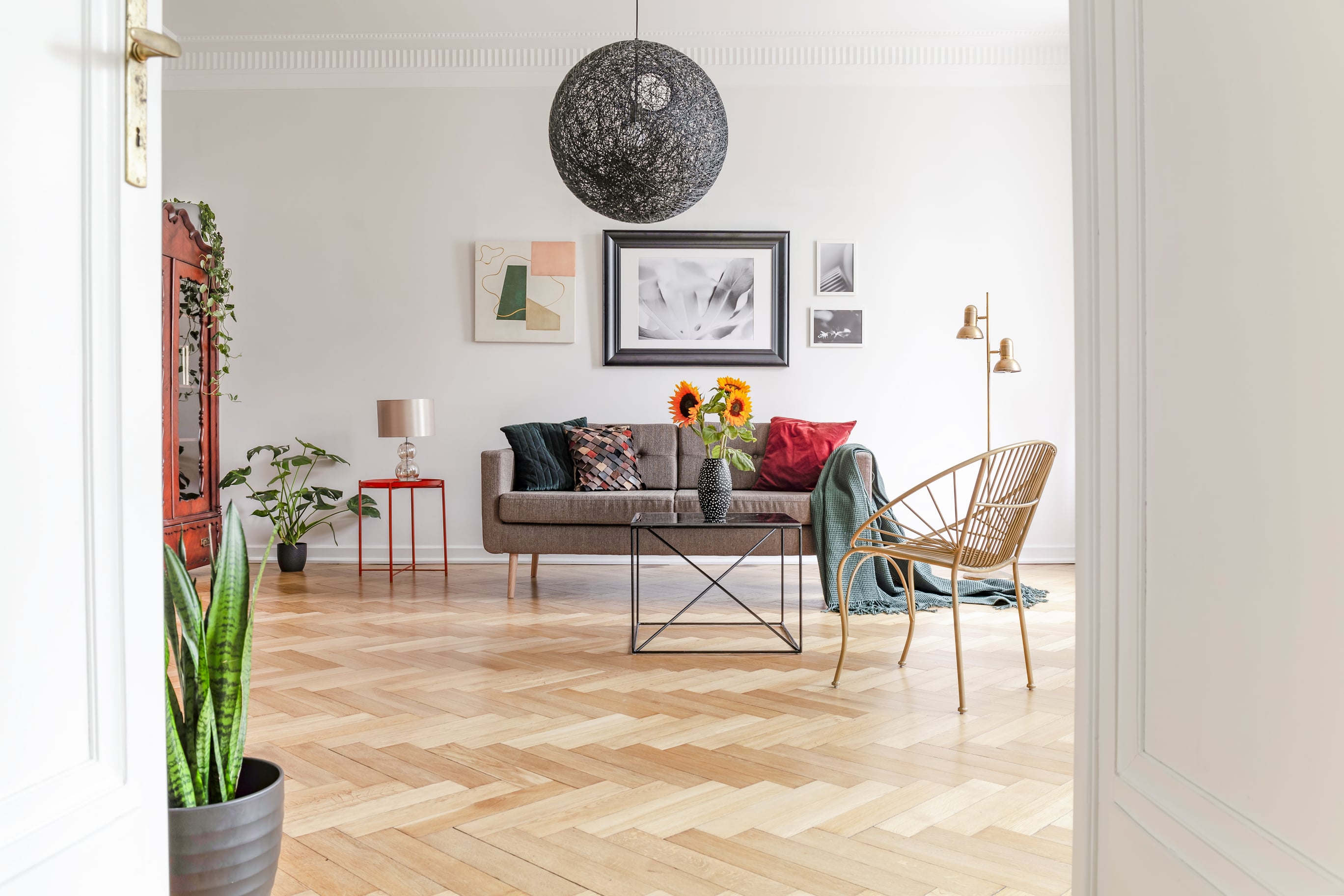
Timeless beauty and lasting value — hardwood adds warmth and character to any room and can be refinished for decades of life.
Hardwood flooring remains the gold standard for homeowners who want lasting beauty and long-term home value. In Utah, where natural aesthetics and mountain-modern design are popular, hardwood delivers the warmth and character that no other flooring can fully replicate. Oak, hickory, maple, and walnut are the most requested species, each offering a distinct grain pattern and hardness level. The choice between solid and engineered hardwood matters significantly in Utah. Solid hardwood — milled from a single piece of timber — performs best on main floors and upper levels where moisture is not a concern. Engineered hardwood, built from a real hardwood veneer bonded to a plywood or HDF core, handles the humidity and temperature fluctuations of basements, mountain homes, and concrete-slab construction far better. Engineered is also the safer choice at elevations above 5,000 feet, where Utah’s dry air can cause solid planks to shrink and gap if not properly acclimated. At Ogden’s, our showrooms carry both solid and engineered hardwood in a range of widths, finishes, and price points. Every installation includes professional acclimation guidance, subfloor preparation, and a finished result you will enjoy for decades.
| Room | Solid | Engineered | Notes |
|---|---|---|---|
| Living room / main floor | Yes | Yes | Either works well above grade |
| Bedrooms (upper level) | Yes | Yes | Solid is popular for its warmth |
| Kitchen | Caution | Yes | Engineered handles spills better |
| Basement | No | Yes | Must use engineered with moisture barrier |
| Bathroom | No | No | Consider luxury vinyl or tile instead |
Utah homes sit between 4,200 and 7,000+ feet in elevation. Higher altitude means lower humidity, which causes wood to dry faster. If you live in Heber, Park City, or anywhere above 5,500 feet, engineered hardwood is generally the safer long-term choice. If you go with solid, invest in a whole-home humidifier and keep indoor humidity between 35–55% year-round.
Oak (Red and White) The most common hardwood floor in Utah homes. Red oak has a warm, pinkish tone with prominent grain. White oak is slightly harder with a cooler, more neutral palette that suits modern and farmhouse styles. Janka hardness: 1,290–1,360.
Hickory The hardest domestic species commonly available (Janka 1,820). Its dramatic grain variation and natural color range — from creamy blondes to deep browns — make it a popular pick for rustic and mountain-modern Utah homes. Hides dents and scratches better than softer species.
Maple A clean, uniform grain with a light, contemporary look. Slightly harder than oak (Janka 1,450). Works well in modern and minimalist interiors. Shows less grain variation, so the floor reads as smoother and more consistent.
Walnut A rich, dark brown with subtle purple undertones. Softer than oak (Janka 1,010), so it dents more easily — best for lower-traffic areas like formal living rooms and master bedrooms. Adds a luxury feel that pairs well with upscale interiors.
Sweep or dust-mop daily. Damp-mop with a hardwood-specific cleaner (never wet-mop). Recoat the finish every 5–7 years and sand fully every 15–20 years. In Utah’s dry winter air, run a humidifier to prevent gapping between planks.
Visit a showroom to see and feel the difference, or have our Mobile Flooring Showroom bring samples to your home.